RESOURCES
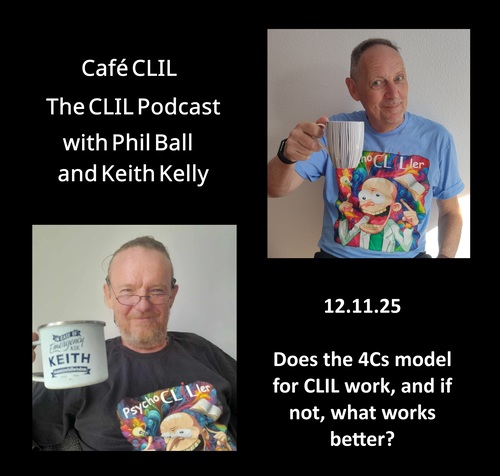
Cafe CLIL - The 4Cs
The 4Cs - Does the 4Cs model for CLIL work, and if not, what does it better?AI Summary and links
Revisiting the 'Four C's' in CLIL
Keith and Phil discussed the evolution and critique of the "Four C's" framework in CLIL , highlighting its lack of structural coherence and the need to challenge existing hypotheses for progress. They noted that while the framework's components are useful, the package as a whole may be overcomplicated, and they considered alternative approaches like the three dimensions of concepts, procedures, and language. Keith emphasized the importance of cultural and intercultural aspects in CLIL, while Phil acknowledged the intercultural nature of studying in a foreign language but criticized the English national curriculum for its limited focus on intercultural competence.
Cultural Integration in Language Learning
They discussed the integration of cultural elements into language learning, particularly focusing on the "small c" approach, which includes cultural references like Halloween, as opposed to the "big C" approach that involves a more comprehensive study of culture. They emphasized the importance of aligning national curriculum guidelines with intercultural communication theory to ensure cultural skills are developed effectively. Keith introduced a matrix which outlines the need for learners to understand both their own and another culture's perspectives, and they discussed the benefits of classroom partnerships for fostering these skills.
Culture in CLIL Education
The role of culture in education was discussed, particularly in the context of CLIL. They agreed that culture can be an important aspect of teaching, especially through projects like e-twinning where students and teachers have chosen to participate. However, they also acknowledged that culture may only be an add-on to the curriculum in many countries where the national curriculum is mandatory. Phil suggested that critical pedagogy can be incorporated into CLIL teaching, making it more engaging for students who are learning in a second or third language.
Language in Education: A New Perspective
They discussed the role of language in education, challenging the traditional view that all teachers are language teachers. They argued that language should be considered content across the curriculum, particularly for subject teachers teaching in second languages. They touched on the importance of attitudes in curriculum design and the need to recognize language as a crucial component of subject teaching.
Integrating Attitudes in CLIL Education
Phil and Keith discussed the role of attitudes in CLIL, emphasizing that attitudes are an essential but challenging dimension to assess in education. They agreed that attitudes should be integrated naturally into teaching rather than overcomplicating them with additional dimensions. Keith shared examples from his work with the British Council, highlighting how cultural competence can be developed through practical activities that encourage students to explore different perspectives and share experiences. They concluded that teachers need accessible tools and frameworks, like the three dimensions of CLIL, which help them understand and implement these concepts effectively in their classrooms.
Integrating Culture in CLIL Teaching
They discussed integration of cultural and community elements into CLIL teaching, with both agreeing that culture should emerge naturally from teaching dynamics rather than being shoehorned into a four-tier package. They explored how science topics like climate change can serve as a natural entry point for intercultural learning, noting the increased possibilities for cross-cultural communication due to digital technology. The discussion concluded with examples of Bulgarian cultural experiences Keith shares with visiting teachers, suggesting that cultural mediation and authentic experiences are valuable components of CLIL teaching.
Links
https://www.factworld.info/cache/files/93.pdf Ethical English
https://www.factworld.info/cache/files/94.pdf Share your world