RESOURCES
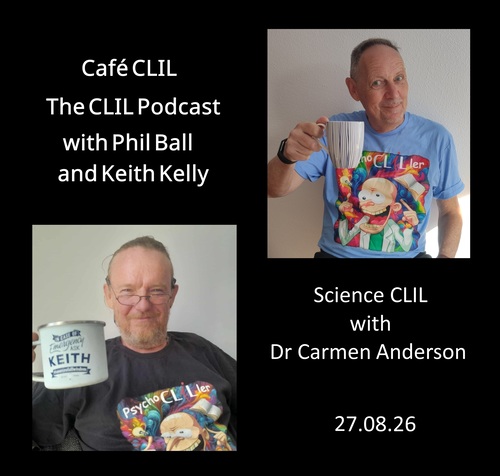
Cafe CLIL - Science CLIL (part I)
Cafe CLIL 25 - Science CLILCafé CLIL 25 looks at Science CLIL and we are lucky to have Dr Carmen Anderson who, among many other things, teaches Science through English in the Basque Country. I have to say I’m a little jealous of Carmen’s students, talk about a Dream Teacher!!! Carmen and Phil discuss a range of issues related to upper Secondary Science CLIL. Science Culture is at the heart of the approach taken in the schools where Carmen works, and she stresses the importance of the social responsibility we all carry to be Science literate.
Related books given through the text below.
Carmen also says something which rings so true with me and that is Hands on – when it’s hands on you can make it salient (you can touch it, hear it, see it)
((My Stroke of Insight by Gill Bolte Taylor talks about learning with all of the senses.))
((Braiding Sweetgrass by Robin Kimmerer describes how the institution of Science itself is biased and missing out on other perspectives than the Western scientific model.))
I love the discussion about being wrong being at the heart of the scientific approach. Asking probing questions and testing results is what it’s all about. Be wrong – Embrace your errors, it’s where the truth is!
((Kathryn Schulz – Being Wrong – Adventures in the Margin of Error))
Phil and Carmen touch on Critical Thinking skills through Science and its importance in today’s world. – Is it true? Can you absolutely know it’s true?
((Love what is – Byron Katie))
I agree with everything Carmen says about checking truth and validity.
Carmen also stresses the three dimensions of CLIL (Concepts, Procedures and Language) and says that it makes perfect sense to do science through English. I would add, or any other language of learning. While you touch on English for Science in the world of work, the medium is ultimately learnable through the science whatever the language.