RESOURCES
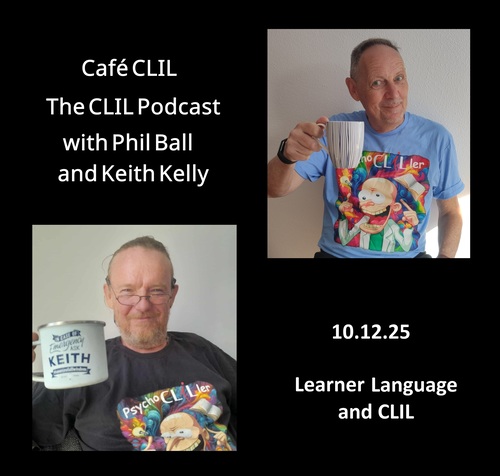
Cafe CLIL - Learner Language and CLIL
![[/userfiles/files/Cafe%20CLIL%2009%20-%20Learner%20Language%20and%20CLIL%20banner%20-%20final.jpg]](/userfiles/files/Cafe%20CLIL%2009%20-%20Learner%20Language%20and%20CLIL%20banner%20-%20final.jpg "/userfiles/files/Cafe%20CLIL%2009%20-%20Learner%20Language%20and%20CLIL%20banner%20-%20final.jpg")
Mr Phil Ball and I will meet on Wednesday 10.12.25 for Cafe CLIL 09 - Learner Language and CLIL. We will discuss what learners need to be able to succeed in a subject in a foreign language. We define language principles, and we define what language for learning is in 3 layers. There are many links to share resources and we will talk about simple steps teachers can take to make curriculum language salient. Put the kettle on and come and join us.
#CLIL #cafeclil #puttingclilintopractice
Quick recap
The conversation revolved around teaching and learning academic language, emphasizing the importance of auditing language demands in curriculum subjects and the role of AI in facilitating language audits.
Understanding Layers of Learner Language
Keith and Phil discussed the complexity of learner language, focusing on three layers: subject-specific language, general academic language, and peripheral language. They reviewed seven principles for using language in teaching, including mediating language between learners and new knowledge, developing subject language awareness, and creating initial talk time for students. Phil introduced a quadrant framework by Mariani to analyze challenge and support in student language use.
Academic Language Teaching Challenges
Phil and Keith discussed the challenges of teaching and learning academic language, particularly focusing on low-frequency words like "thus." Phil explained that such words can be syntactically and conceptually difficult for non-native learners, as they require understanding of grammatical position and the ability to connect propositions. They agreed to include a visual diagram to illustrate this concept in their future podcast edit.
Mariani's Quadrant: Classroom Analysis
Phil and Keith discussed Mariani's Quadrant, a tool for analyzing classroom environments based on challenge and support levels. They explored the four quadrants: the Northwest (high challenge, high support), the Northeast (high challenge, low support - the "frustration zone"), the Southeast (low challenge, low support - the "boredom zone"), and the Southwest (high support, low challenge - the "comfort zone"). Phil emphasized the importance of aiming for the Northwest quadrant, where students are both challenged and supported. Keith shared that John Clegg's work on language in curriculum areas inspired his research on categorizing teacher and learner language in different subject areas.
Language Demands in Curriculum Subjects
Keith and Phil discussed the importance of auditing and making explicit the language demands in curriculum subjects, particularly for English as an Additional Language (EAL) learners. They explored practical strategies for teachers to identify and provide crucial language to students, using examples like the parachute jump task in mathematics. The conversation highlighted the role of AI in facilitating language audits and the need for teachers to plan lessons with language in mind. They also touched on the concept of "stretched language" and the importance of curriculum mapping to integrate language across subjects.
Links
FACT 35 - https://www.factworld.info/en/Bulgaria-FACT-Journals-Issue-35
EAL network UK - https://naldic.org.uk/
Mariani framework - https://www.learningpaths.org/papers/papersupport.htm
Emails:
keith@anglia-school.info
ball.philip6@gmail.com