RESOURCES
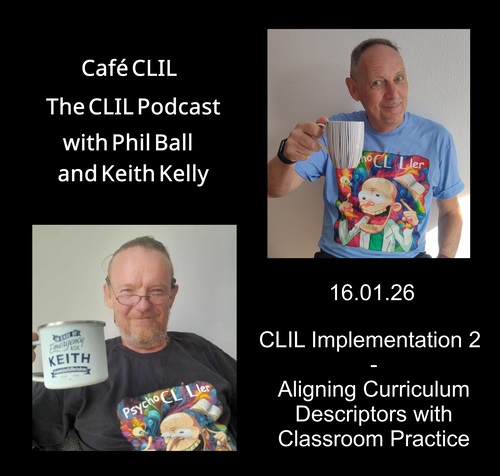
Cafe CLIL - Implementing CLIL part 2 - Aligning Curriculum with Practice
Cafe CLIL - Implementing CLIL: Aligning Curriculum Descriptors with Classroom Practice![[/userfiles/files/Cafe%20CLIL%2011%20-%20CLIL%20Implementation%202.jpg]](/userfiles/files/Cafe%20CLIL%2011%20-%20CLIL%20Implementation%202.jpg "/userfiles/files/Cafe%20CLIL%2011%20-%20CLIL%20Implementation%202.jpg")
Summary (AI Generated)
Curriculum Design and Language Integration
Keith and Phil discussed Biggs' work on curriculum design, particularly focusing on language integration and constructivist teaching methods. They agreed to start their presentation with language aspects, including Mercer's work on exploratory talk, and planned to reference several academic sources including Ferent Marton and phenomenography. The discussion highlighted how CLIL (Content and Language Integrated Learning) effectively combines language focus with practical procedures, and they noted that assessment must also align with these principles.
CLIL and Constructive Alignment
Phil and Keith discussed the alignment of teaching and learning activities with intended learning outcomes and assessment tasks, as proposed by Biggs' constructive alignment theory. They explored how CLIL (Content and Language Integrated Learning) facilitates this alignment by focusing on the language demands of curriculum concepts and procedures. Mercer's work on exploratory, disputational, and cumulative language was also mentioned in relation to CLIL's sequential approach to teaching. Keith shared examples from his teaching experience, highlighting how CLIL can effectively connect language with conceptual learning.
Constructive Alignment in Language Teaching
Keith and Phil discussed the concept of constructive alignment in curriculum design, particularly focusing on how it connects to constructivism and language teaching. They explored practical examples from early years education, including experiments with floating and sinking objects, and how these activities naturally incorporate language learning through context. They emphasized that language should emerge naturally from curriculum activities rather than being taught in isolation, and that teachers should be aware of the language demands of their curriculum objectives.
Learner-Centered Education Strategies
Phil and Keith discussed the importance of focusing on what learners are expected to do rather than what teachers want to teach, drawing on Biggs' concept of procedural dimensions in education. They explored how this approach applies across different levels of education, from preschool to university, and how it can be used to create more engaging and effective learning experiences. Phil also shared an example of curriculum alignment, highlighting a misalignment between intercultural awareness in the curriculum and the monolingual scholastic setup in the UK.
Curriculum Adaptation and Assessment Strategies
Phil and Anglia discussed curriculum descriptors and assessment methods, particularly in relation to Biggs' work on deeper learning and interrelational concepts. They explored how to adapt traditional curriculum descriptors to include procedural and linguistic elements, using the example of teaching about the solar system and ended with a hint at doing a discussion on assessment in CLIL.
Links:
Biggs
Teaching for quality learning at university
Mercer (full text)
https://www.tandfonline.com/doi/full/10.1080/09500782.2018.1509988