RESOURCES
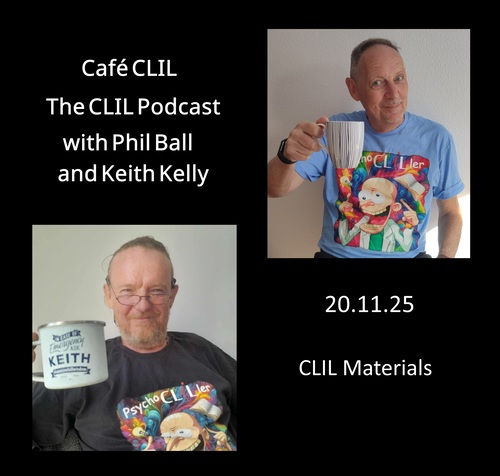
Cafe CLIL - CLIL Materials
Mr Phil Ball and I will meet on Thursday for Cafe CLIL 06 - CLIL Materials where we will chew the fat about what makes for good CLIL materials, and we have a very welcome contribution from colleague and CLIL materials writer Amanda Mcloughlin.As usual, get your tea, coffee, herbal, whatever you prefer and come and join us.
#CLIL #cafeclil #puttingclilintopractice
AI Summary
CLIL Materials Discussion Overview
Phil and Keith discussed the need for several sessions to cover the extensive topics related to CLIL materials and their implications for education. Keith mentioned the importance of visual learners and the need to visualize concepts, aligning with their CLIL in three dimensions approach. They agreed to start the discussion by addressing what characterizes CLIL materials, with a focus on the seven principles and contributions from Mandy regarding scaffolding and sequencing.
CLIL Materials and Task-Based Learning
Keith and Phil discussed the characteristics of CLIL materials, focusing on the primacy of task and the importance of clear instructions for students. They emphasized that if students know what to do, the text becomes a tool to facilitate tasks rather than a barrier. They also touched on the relevance of vocational contexts in learning, using examples from their experience in Austrian vocational schools.
Enhancing Student Communication Through Activities
Keith and Phil discussed the importance of focusing on what students are expected to do rather than just reading and answering questions. They emphasized the need to make decisions about how language is embedded within activities, highlighting the significance of manipulative activities that allow students to communicate their understanding. Phil suggested using texts as a tool to facilitate other actions, rather than the dominant paradigm of reading and answering questions, which he believes has made the concept of text frightening for students.
Text Dominance in Education Systems
Phil and Keith discussed the dominance of text in education, particularly in general education systems compared to vocational training. They explored how textbooks often lack visual elements, with Keith sharing an example of a history textbook that omitted all pictures during translation. The conversation touched on Content and Language Integrated Learning (CLIL), where making things visible to students is crucial, especially in terms of academic language and text genres. They also mentioned cognitive discourse functions and the importance of helping students master different text types, such as description and explanation.
Interactive Learning for Language Engagement
Phil and Keith discussed the importance of breaking down complex concepts in language learning, particularly in CLIL (Content and Language Integrated Learning). They explored how visualizing content through activities like tree diagrams can help students engage with and process information in a foreign language. Phil shared an example of using interactive procedures to make geographical content more interesting to students, such as discussing the demographics of a small industrial town. They agreed that manipulating procedures and making learning activities interactive can make even challenging topics like heavy industry engaging for students.
Scaffolding and Sequencing in Materials Design
Keith and Phil discussed Mandy's insights on scaffolding and sequencing in materials design, emphasizing the importance of visualizing concepts and making academic language visible in CLIL. They explored how scaffolding can be shaped to fit concept structures and how sequencing involves gradually increasing the complexity of materials. Phil highlighted the need for careful differentiation and the use of Universal Design for Language principles, while also noting the importance of eventually removing scaffolding to challenge students. The discussion touched on practical examples, such as teaching young learners about pollination, to illustrate these concepts.
Drama in Education: Scaffolding Abstract Concepts
Keith and Phil discussed the importance of using drama and role-playing in education, particularly for younger students. They agreed that these methods help make abstract concepts more concrete and accessible to learners. Phil suggested that dressing up as bees could be considered a form of scaffolding, which Keith supported. They also touched on the broader concept of scaffolding in language teaching and materials development, with Phil mentioning Brian Tomlinton's principles for learner-centered materials.
CLIL Principles and Teaching Approaches
Phil and Keith discussed the principles of CLIL (Content and Language Integrated Learning), focusing on the need for authentic, engaging, adaptable, and interactive materials that support communicative competence, particularly in subject disciplines. They highlighted the importance of visual thinking and conceptual approaches in CLIL, contrasting it with traditional language teaching methods that often focus on lexical and grammatical aspects. The conversation concluded with an agreement to explore scaffolding and sequencing in future sessions, potentially inviting an expert from pure language teaching to provide additional perspectives.
Language Teaching Materials Discussion
Keith and Phil discussed their previous conversation about language teaching materials and concepts, noting that they had covered a lot of ground but could go deeper into certain topics.